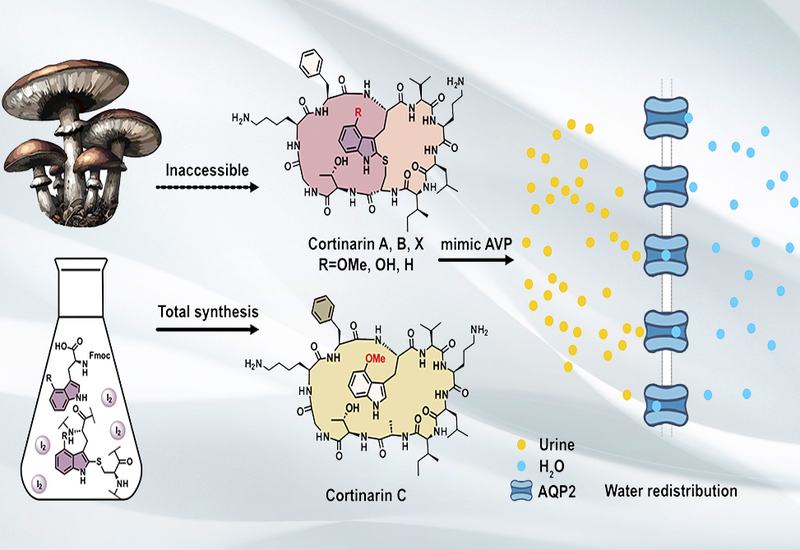
Mushroom poisoning by species of the genus Cortinarius poses a persistent clinical challenge. The principal nephrotoxin, orellanine, acts via metal complexation and reactive oxygen species generation, causing kidney damage that may not manifest for up to 20 days after ingestion. A second family of toxic constituents, the cortinarins, were isolated in 1984 from Cortinarius speciosissimus and proposed as bicyclic peptides bearing a tryptathionine bridge, the same Trp–Cys crosslink that defines the death cap toxins phalloidin and amanitin. Initial animal assays implicated cortinarins A and B in nephrotoxicity and suggested a mechanistic connection to the peptide hormone arginine vasopressin, AVP. Yet without a reliable biological supply or synthetic route, those leads went uninvestigated for four decades.
Researchers in the Süssmuth Group at Technische Universität Berlin, the Klussmann Group at the Max-Delbrück-Center for Molecular Medicine in the Helmholtz Association, and the Yao Group at the Greater Bay Area Institute of Precision Medicine, published in Chemical Science, developed the first total synthesis of cortinarins A and B as well as monocyclic cortinarin C. The strategy centers on an iodine-mediated oxidative Trp–Cys cyclization on solid support, a method the Süssmuth group had previously validated for phalloidin and amanitin. Non-commercially available building blocks Fmoc-L-Trp(4-OMe)-OH and Fmoc-L-Trp(4-OBn)-OH were prepared over seven steps via asymmetric metal-catalyzed hydrogenation, then integrated into linear peptide sequences by Fmoc SPPS. Macrolactamization with HATU at 2 mM peptide concentration closed the ten-membered ring, and global deprotection with TFA or BF3·Et2O afforded the target compounds in milligram quantities.
The tryptathionine bridge in bicyclic systems generates non-classical atropisomers, termed ansamers, defined by whether the bridge sits above or below the macrocyclic plane. Ansamer formation was pronounced in the simplified analog cortinarin X, CorX, yielding a P-ansamer and an M-ansamer in roughly a 9:1 ratio, separable by preparative HPLC. Assignment relied on a diagnostic NOE cross-peak between the Hα protons of Trp3 and Cys8: the M-ansamer showed a strong signal corresponding to a proton–proton distance of approximately 2.7 Å, while the P-ansamer showed no detectable cross-peak at approximately 7.5 Å. CD spectra, UV absorption maxima, and 1 μs molecular dynamics simulations in DMSO corroborated the assignment and confirmed that neither ansamer undergoes thermal interconversion under the conditions tested. For the natural products cortinarins A and B, indole oxidation at the 4-position sterically suppresses ansamer formation to below 5%, and both were identified as P-ansamers, consistent with phalloidin and amanitin. NOE-restrained structure calculations revealed that CorX adopts β-turn conformations: the P-ansamer features a type II′ β-turn at Cys8–Lys1 and a type IV β-turn at Trp3–Leu6, while the M-ansamer carries a type IV β-turn at D-Thr9–Phe2 and a type I β-turn at Val4–Ile7.
Biological evaluation in MCD4-V2R cells, a renal principal cell model that stably expresses human aquaporin-2, AQP2, and the vasopressin V2 receptor, showed that both CorX ansamers and monocyclic cortinarin C promote redistribution of AQP2 to the plasma membrane at 20 μM, mimicking the effect of AVP at 100 nM. Cortinarins A and B showed no measurable activity under those conditions. A CorX analog in which Lys1 and Orn5 were replaced by alanine lost all activity in both ansamer forms, identifying the free amino groups as critical for target engagement. Mechanistic probing distinguished the cortinarin mode of action from that of AVP: whereas AVP signaling through the V2 receptor reduces AQP2 phosphorylation at Ser261, the P-ansamer of CorX left this phosphorylation unaffected, indicating engagement with a distinct cellular pathway downstream or parallel to cAMP–PKA signaling.
The synthesis delivers gram-accessible quantities of cortinarins for rigorous pharmacological study and removes the bottleneck that had stalled this field since 1984. The observation that CorX promotes AQP2 membrane localization independently of V2R–cAMP signaling opens a structurally distinct entry point toward therapies for diabetes insipidus, a disorder in which AQP2 mis-localization can produce daily urinary losses of up to 20 L. The authors note that the precise mode of action requires further elucidation, and that the relative contributions of monocyclic cortinarin C and the bicyclic ansamers to the cellular phenotype remain open questions. Cortinarin-type cyclopeptides now stand as a tractable chemical scaffold for lead optimization in renal water-balance disorders.